
Wash timer and controls
Select wash duration and operating functions. Mechanical timers are common, but control details differ by appliance.
Labeled semi automatic washing machine parts, functions, related symptoms and repair limitations. Educational schematic; actual construction depends on the model.
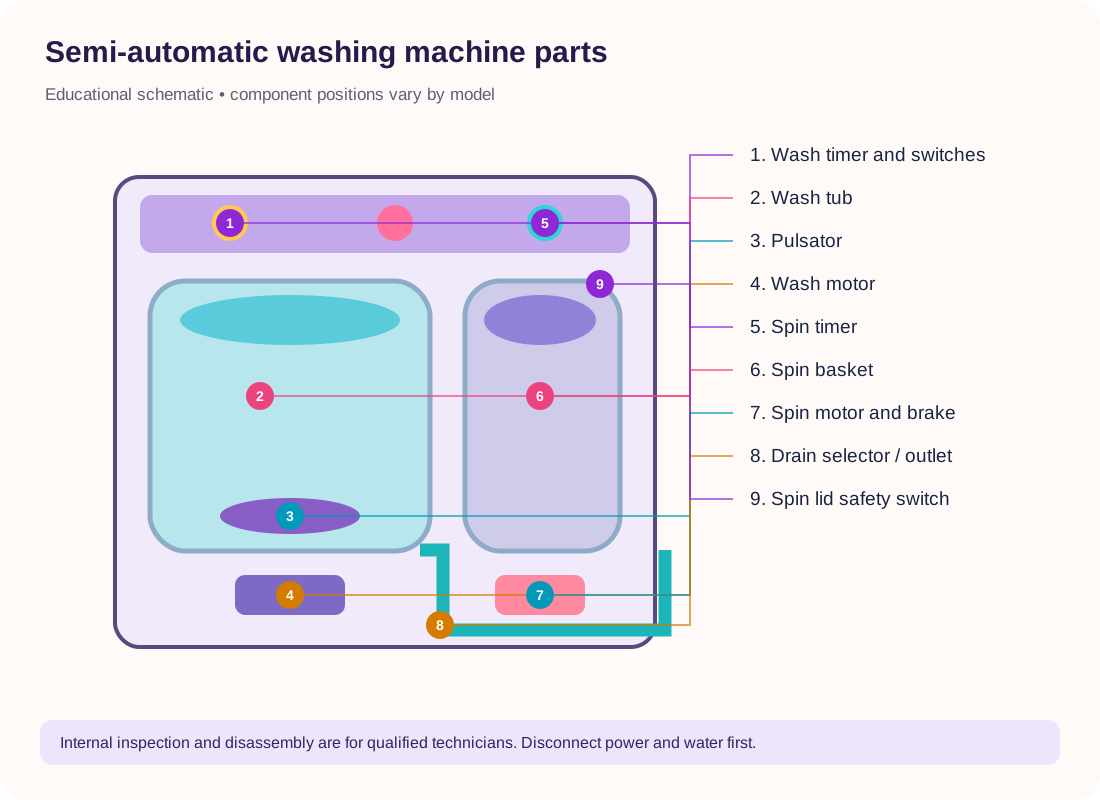
Select wash duration and operating functions. Mechanical timers are common, but control details differ by appliance.
Holds water and laundry during washing. The user normally manages water filling and transfers clothes to the spin tub.
Moves the wash load at the bottom of the wash tub. An obstruction, belt, shaft or drive fault can affect movement.
Drives the washing side through the model’s transmission arrangement. Capacitors and internal electrical components require qualified testing.
Sets spin operation. A failure to spin can also involve the lid safety mechanism, brake or drive, rather than the timer itself.
Removes water from laundry in the separate spin compartment. Balanced loading and the correct retaining cover are important.
Drive and stop the spin basket. The braking and lid-safety arrangement must remain intact; do not bypass it.
Release wastewater through the outlet arrangement. Hose bends, selector linkages and blockages are assessed before assuming a major fault.
Restricts spinning when the lid is open. A failed or damaged safety component is a reason to stop use and arrange repair.
Laundry is washed in the main tub with the selected water level and wash time. The user drains or changes water as required by the instructions, then transfers a suitable amount of laundry into the spin basket. A spin cover or safety plate may be required by the model, and the lid-safety system must remain functional. Spin performance depends on correct load distribution as well as the motor, braking and suspension arrangement. Drainage may use a mechanical selector and gravity or another model-specific system. No single timer, capacitor or motor arrangement applies to every twin-tub washer.
Water entry, level sensing, wash motion, draining and spinning depend on several systems working together. A blocked drain may prevent spinning even when the motor is healthy. A door-lock fault can stop the programme before water enters. This is why a symptom should be traced through the actual operating sequence rather than linked to a single part name.
Older twin-tub machines may have brittle plastic or corrosion that limits dismantling. A motor, capacitor or timer must be matched to the machine rather than selected by appearance. Some tub damage is uneconomical to repair. The engineer will explain whether a functional repair is practical before additional parts or workshop work are approved.
Call 9413778916 to discuss the fault, machine type, model and location. Confirm the visiting charge, availability and proposed work before booking.
Call 9413778916 ↗