
Controls and PCB
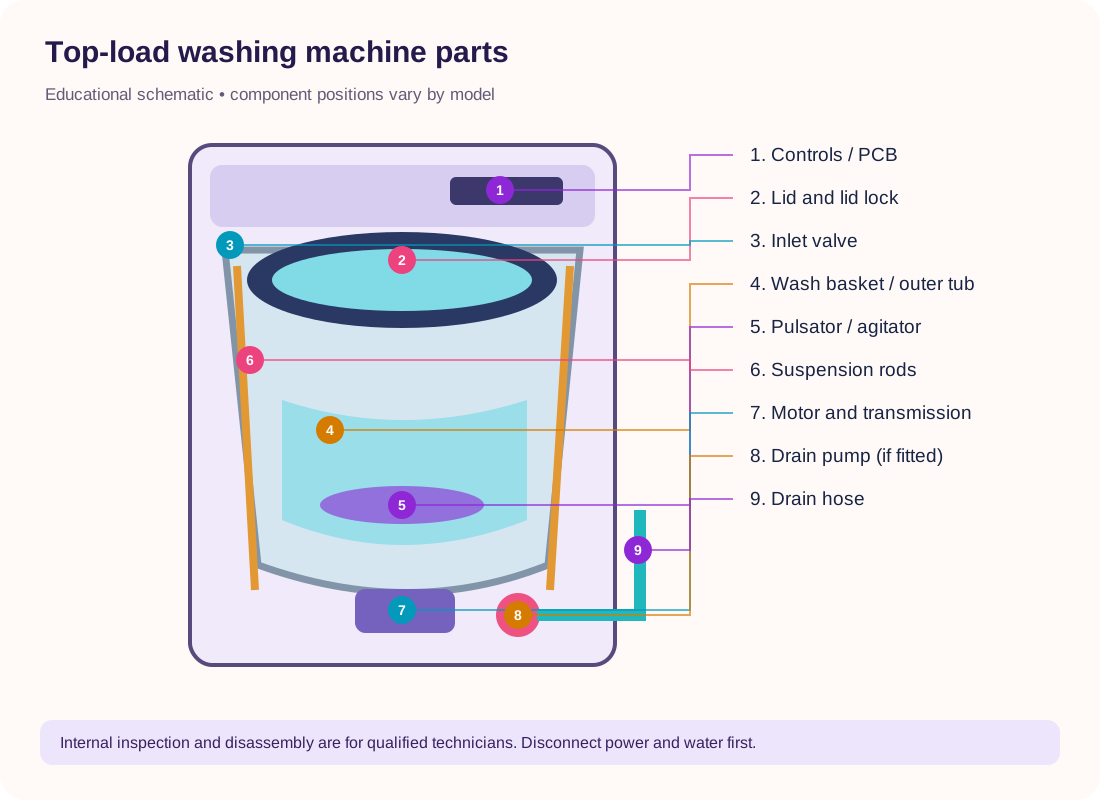
Coordinates fill, wash, drain and spin using information from safety and sensing components. Control-board diagnosis includes the connected wiring and loads.
Labeled top load washing machine parts, functions, related symptoms and repair limitations. Educational schematic; actual construction depends on the model.
Coordinates fill, wash, drain and spin using information from safety and sensing components. Control-board diagnosis includes the connected wiring and loads.
Allows access to the vertical basket and helps prevent unsafe spinning with the lid open. Never bridge a lid switch or safety lock.
Admits water as required by the programme. Supply flow and the accessible hose are checked before a replacement is proposed.
The inner basket contains the laundry and the outer tub holds water. Tub, bearing and seal arrangements differ by model.
Moves water and clothing during the wash. Some designs use a low pulsator and others a taller agitator; a loose item or drive problem can reduce washing action.
Support and steady the tub. Repeated imbalance may come from loading, leveling, suspension, a damaged basket or another mechanical issue.
Provide the washing and spinning motion. Belt, clutch, gearbox and direct-drive systems are design-dependent; not all are fitted to every machine.
Transfers wastewater on pump-drain models. Some designs use a different drainage arrangement, so identify the actual machine before diagnosing a component.
Routes wastewater from the machine. Follow the correct hose position and installation limits in the manufacturer’s guide.
The controller admits water to the selected level and operates the wash mechanism to move laundry through detergent solution. Used water leaves through the model's drainage arrangement before rinses and spinning. During spin, the basket rotates at higher speed and its suspension helps manage the load. Some machines check balance and may pause or adjust the cycle when laundry is uneven. Lid-safety systems restrict operation when access is unsafe. Drive methods, drain-pump arrangements and heating features vary, so service checks should follow the individual machine instead of treating every top-loader as mechanically identical.
Water entry, level sensing, wash motion, draining and spinning depend on several systems working together. A blocked drain may prevent spinning even when the motor is healthy. A door-lock fault can stop the programme before water enters. This is why a symptom should be traced through the actual operating sequence rather than linked to a single part name.
Drive layouts and drain systems vary substantially across top-load models. Some use an impeller and others an agitator; some include heating and many do not. The engineer must confirm the construction before quoting. A replacement lid switch must preserve its safety function, and a damaged basket or gearbox can change repair feasibility.
Call 9413778916 to discuss the fault, machine type, model and location. Confirm the visiting charge, availability and proposed work before booking.
Call 9413778916 ↗